Naming Is the Entry Point to Precision Agriculture
Precision and smart farming increasingly rely on image-based decision systems, and those decisions begin with correctly naming what appears in a field photograph. Farmers, breeders, and quarantine officers must identify a crop variety, livestock breed, pest insect, or invasive weed before selecting a control product, managing a breed record, enforcing quarantine, monitoring biodiversity, or forecasting yield. A wrong name can therefore send the downstream decision to the wrong organism.
We call this task open-ended taxonomic naming: producing an agricultural entity name without choosing from a predefined label set. The term is used operationally here to cover recognized organism names and, for Livestock, recognized breed names. Unlike closed-set classification, it requires both visual discrimination and access to scientific names, common names, aliases, and biological relationships.
AgriTaxon is a knowledge-grounded and AI-ready benchmark suite spanning Crops, Livestock, Pests, and Weeds. Each core entity is linked through Wikidata to FAO Ecocrop, FAO DAD-IS, or the EPPO Global Database and paired with machine-readable identifiers, a canonical name, collected aliases, a domain label, and an executable evaluation protocol. We evaluate 14 multimodal foundation models using four-option recognition and open-ended naming; the alias-aware LLM judge agrees with a domain expert on 98% of 100 audited exact-match errors.
Core, Hard, and In-the-Wild Evaluation
The core benchmark measures broad agricultural entity naming. AgriTaxon-Hard is a performance-conditioned diagnostic subset, while AgriTaxon-Wild evaluates the same naming capability using multiple independent field observations.
| Dataset | Purpose | Entities | Images |
|---|---|---|---|
| AgriTaxon Core | Broad taxonomic-naming benchmark | 7,432 | 7,432 |
| AgriTaxon-Hard | Performance-conditioned diagnostic stress test | 1,052 | 1,052 |
| AgriTaxon-Wild | Field-condition evaluation | 2,969 | 14,845 |
AgriTaxon-Hard contains core samples answered correctly by at most two of the 14 evaluated models under the default multiple-choice protocol. It is intended for failure analysis and tool-assisted recovery, not as an estimate of average benchmark performance.
AgriTaxon-Wild uses strict Wikidata P3151 alignment to iNaturalist, without fuzzy name matching. It retains 2,969 entities with five qualifying field photographs each and evaluates one, three, or five views of the same entity.
Leaderboard
Accuracy (%) on AgriTaxon for 14 LMMs, ranked by OE-Acc within each block. MC Macro, OE-EM, and OE-Acc are unweighted macro-averages across the four tracks; the four track-specific open-ended columns report EM. Bold = best per column.
| Model | Release | Hard | Multi-Choice | Open-Ended | |||||||||
|---|---|---|---|---|---|---|---|---|---|---|---|---|---|
| Crop | Live. | Pest | Weed | Macro | Crop | Live. | Pest | Weed | EM | Acc | |||
| Proprietary Models | |||||||||||||
 gemini-3-pro-preview gemini-3-pro-preview |
2025.11 | 9.0 | 83.7 | 95.5 | 72.5 | 78.1 | 82.5 | 43.6 | 49.4 | 30.0 | 53.0 | 44.0 | 51.2 |
 doubao-seed-2-0-pro doubao-seed-2-0-pro |
2026.02 | 6.0 | 81.3 | 88.8 | 70.9 | 76.6 | 79.4 | 45.3 | 35.4 | 39.6 | 56.6 | 44.2 | 48.8 |
| gemini-3-flash-preview |
2025.12 | 8.7 | 84.9 | 95.1 | 72.7 | 79.1 | 83.0 | 22.4 | 37.6 | 22.9 | 50.4 | 33.4 | 48.1 |
| doubao-seed-2-0-lite |
2026.02 | 5.6 | 78.1 | 87.6 | 70.1 | 74.7 | 77.6 | 37.3 | 34.3 | 30.5 | 48.8 | 37.7 | 44.2 |
 gpt-5 gpt-5 |
2025.08 | 8.4 | 79.1 | 92.9 | 68.8 | 73.3 | 78.6 | 30.6 | 34.3 | 17.2 | 36.2 | 29.6 | 37.6 |
| gpt-5-mini |
2025.08 | 7.7 | 71.6 | 87.5 | 62.7 | 64.6 | 71.6 | 28.4 | 26.4 | 9.8 | 23.6 | 22.0 | 27.4 |
 claude-haiku-4-5 claude-haiku-4-5 |
2025.10 | 4.7 | 58.1 | 74.5 | 52.9 | 56.2 | 60.4 | 12.5 | 19.7 | 4.0 | 8.6 | 11.2 | 14.7 |
| Open-Source Models | |||||||||||||
 kimi-k2.5 kimi-k2.5 |
2026.01 | 2.1 | 75.0 | 86.0 | 65.8 | 68.0 | 73.7 | 29.8 | 30.9 | 20.0 | 39.2 | 30.0 | 38.1 |
 glm-4.6v glm-4.6v |
2025.12 | 6.2 | 66.7 | 77.0 | 57.9 | 58.6 | 65.1 | 33.2 | 21.3 | 10.4 | 26.6 | 22.9 | 30.5 |
 qwen3-vl-235b-a22b qwen3-vl-235b-a22b |
2025.09 | 2.2 | 66.4 | 81.5 | 63.2 | 62.5 | 68.4 | 23.5 | 24.2 | 13.5 | 25.8 | 21.7 | 27.6 |
| qwen3.5-397b-a17b |
2026.02 | 9.2 | 70.5 | 85.4 | 65.8 | 65.8 | 71.9 | 25.3 | 23.6 | 13.8 | 24.8 | 21.9 | 27.1 |
| qwen3-vl-30b-a3b |
2025.10 | 2.2 | 59.2 | 70.1 | 55.9 | 54.6 | 59.9 | 19.9 | 24.2 | 5.3 | 14.6 | 16.0 | 22.5 |
| glm-4.6v-flashx |
2025.12 | 5.8 | 59.3 | 71.3 | 55.4 | 55.1 | 60.3 | 21.6 | 21.3 | 5.7 | 12.7 | 15.3 | 19.9 |
| qwen3.5-35b-a3b |
2026.02 | 4.2 | 67.1 | 80.9 | 61.4 | 61.7 | 67.8 | 11.3 | 18.0 | 3.9 | 12.6 | 11.4 | 17.6 |
Hard = performance-conditioned AgriTaxon-Hard accuracy (≤2 of 14 models correct under the default MC protocol; 1,052 samples). The four OE track columns report exact match after normalization. EM and alias-aware Acc are unweighted macro-averages across the four tracks; the LLM judge agrees with a domain expert on 98% of 100 sampled EM errors.
📬 Submit to Leaderboard — If you would like your model or method to appear on this leaderboard, please contact us at zengx@nercita.org.cn with your evaluation results.
Multiple Field Views Strengthen Recognition in Field Conditions
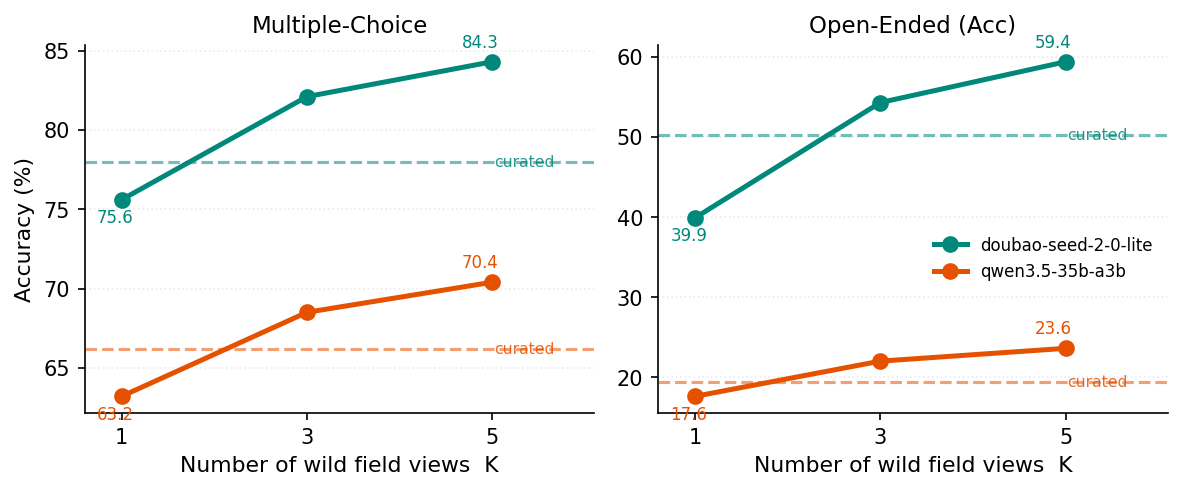
Field photographs vary in viewpoint, background, illumination, life stage, and image quality. AgriTaxon-Wild evaluates the same 2,969 P3151-aligned entities using one curated Commons image or one, three, and five iNaturalist field observations. Candidate names and judging procedures remain fixed, allowing a controlled test of whether corroborating field views improve recognition and naming.
| Model | Setting | MC | OE-EM | OE-Acc |
|---|---|---|---|---|
| Doubao-Seed-2.0-Lite | Curated | 78.0 | 45.0 | 50.2 |
| Wild K=1 | 75.6 | 36.2 | 39.9 | |
| Wild K=3 | 82.1 | 51.0 | 54.3 | |
| Wild K=5 | 84.3 | 55.7 | 59.4 | |
| Qwen3.5-35B-A3B | Curated | 66.2 | 12.7 | 19.4 |
| Wild K=1 | 63.2 | 13.6 | 17.6 | |
| Wild K=3 | 68.5 | 19.5 | 22.0 | |
| Wild K=5 | 70.4 | 21.3 | 23.6 |
A single wild view is harder than the curated image for both models. By K=3, both MC and OE-Acc exceed the corresponding curated baselines, but the seeing-without-naming gap remains at K=5.
Key Findings
- The benchmark is not saturated — the best macro-averaged scores are 83.0% for multiple-choice recognition and 51.2% for alias-aware open-ended naming, while no unaided model exceeds 10% on the performance-conditioned AgriTaxon-Hard stress test.
- Seeing does not guarantee naming — the model scoring 83.0% in multiple-choice recognition reaches only 33.4% OE-EM and 48.1% OE-Acc when candidate names are removed. Every evaluated model retains a gap after valid aliases are credited, which matters when a deployed system must name an entity before supporting an agricultural decision.
- Related-taxon confusion is the largest sampled error category — in a track-stratified sample of 75 Gemini 3 Pro Preview outputs scored as incorrect under alias-aware Acc, 63% name a related but incorrect taxon, risking advice for the wrong organism.
- Globally obscure entities are named least reliably — entities with at most 100 monthly Wikipedia pageviews are answered correctly by 3.40 models on average, compared with 7.57 models above 10,000 views. Pageviews are a proxy for web visibility, not a causal estimate of training frequency; low global visibility can coexist with high local agricultural importance.
- Corroborating field views improve practical recognition — from one to five field images, open-ended accuracy rises by up to 19.5 points (39.9% to 59.4%). A single field view is harder than a curated image, but three views overtake the same-entity curated baseline for both evaluated models.
- Tools recover different hard-case failures — cropping raises Claude Haiku 4.5 accuracy from 4.7% to 10.4% by exposing diagnostic detail, while web retrieval raises GPT-5 Mini from 7.7% to 13.1% by supplying external knowledge.
Explore the Embedding Space
7,432 agricultural entities embedded by Qwen3-Embedding-0.6B and projected via t-SNE. Scroll to zoom, drag to pan, hover for details, click to open Wikipedia.
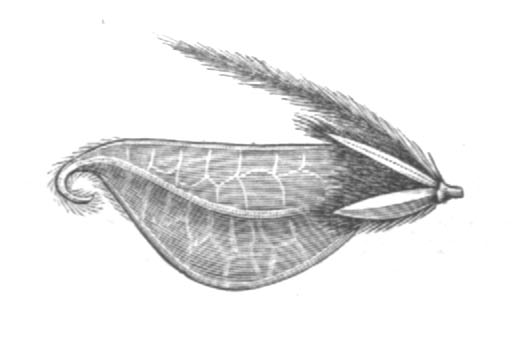
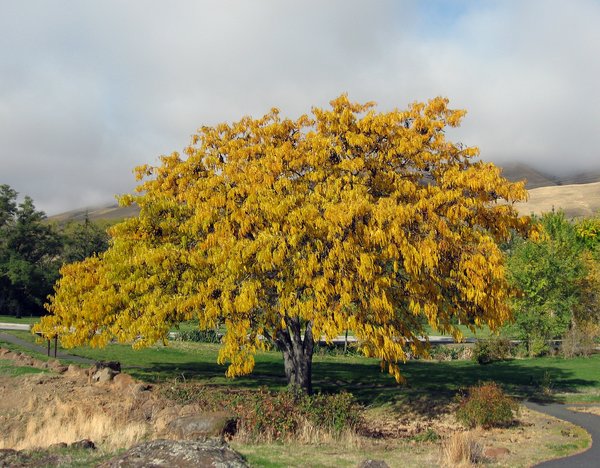
Error Type Examples
Representative examples from the human-annotated 75 Acc-error cases (Gemini 3 Pro Preview, open-ended evaluation).

How AgriTaxon Works
Authority-grounded data collection. We query Wikidata for agricultural entities that carry both an authoritative database identifier (FAO Ecocrop, FAO DAD-IS, or EPPO) and a Wikimedia Commons image, forming a traceable authority chain for organisms and livestock breeds.
Cross-domain coverage. The 48,950 queried EPPO entries—mixing pests, weeds, pathogens, host plants, and other entities—are classified by GPT-5 Mini under predefined criteria; the pest and weed assignments form the corresponding tracks. Resolution filtering removes 154 images whose shorter edge is below 224px. A livestock-specific content check removes six images that do not depict a valid animal instance.
Dual evaluation protocols. Multiple-choice uses text-semantically similar entity names as distractors; open-ended requires independent entity-name production. Open-ended outputs are scored by exact match and alias-aware Acc, with core summary scores macro-averaged across the four tracks.
Implications for Precision and Smart Farming
AgriTaxon studies the recognition step that precedes downstream agricultural decisions and highlights where practical systems need additional visual evidence or external knowledge.
Agricultural Decision Support
Evaluate whether a system can name the organism or breed before recommending control, management, or monitoring actions.
Locally Important Entities
Study why entities with low global web visibility may remain unreliable even when they matter greatly in a local production system.
Structured Knowledge Retrieval
Use FAO, EPPO, and Wikidata identifiers as traceable anchors for retrieving names, aliases, and biological relationships.
Tool-Augmented Recognition
Combine cropping for diagnostic visual detail with web retrieval when parametric knowledge is insufficient.
Field and Quarantine Workflows
Support pest surveillance, quarantine inspection, crop verification, biodiversity monitoring, and livestock breed management.
Multi-View Field Recognition
Test how several independent observations reduce ambiguity caused by viewpoint, occlusion, lighting, and life stage.
Licensing & Access
AgriTaxon is publicly accessible. Reuse of images remains subject to each image's original license and attribution requirements.
- Source code, prompt templates & documentation (this repository): MIT License.
- Benchmark metadata & annotations (entity labels, evaluation splits, distractor sets): released under CC BY 4.0.
- Core images: sourced from Wikimedia Commons and subject to their original licenses.
- AgriTaxon-Wild images: sourced from iNaturalist and subject to their per-photo licenses and attribution requirements; some licenses include NonCommercial or NoDerivatives restrictions.
- Authority identifiers: Wikidata QIDs are available under CC0; FAO and EPPO identifiers are used for reference linking only.
The benchmark suite is hosted on Hugging Face at Xin1818/AgriTaxon. Users should consult the per-image license and attribution metadata distributed with the dataset before reuse.
Getting Started
# Download the dataset from Hugging Face
pip install huggingface_hub
huggingface-cli download Xin1818/AgriTaxon --repo-type dataset --local-dir dataset